Energy is the driving force of every economic system. The transition from muscle power to the steam engine initiated an unprecedented phase of economic development, during which the availability and cost of energy became fundamental determinants of productive capacity. Global energy consumption has increased more than thirtyfold over the past two centuries.1
The oil shocks of the 1970s provided a strong impetus for more efficient energy use. Since then, global energy intensity, defined as the amount of energy required to produce a given level of output, has halved, despite the rise in per capita energy consumption.2 The war in Ukraine and, more recently, the Strait of Hormuz crisis, have nevertheless clearly demonstrated that the global economy remains vulnerable to supply-side disruptions.
Energy shocks affect the economy through multiple channels. They fuel inflation and erode households’ real income, they increase costs and uncertainty for firms, thereby discouraging investment, and they often require costly public interventions.
For Europe, which remains heavily dependent on fossil fuel imports, these shocks have brought the issue of strategic autonomy back to the forefront of policy debates. This is compounded by vulnerability to climate change: Europe and the Mediterranean region are warming at a faster rate than the rest of the planet. Floods, heatwaves, wildfires and droughts are affecting agricultural production, transportation systems, electricity generation, as well as people’s well-being and labour productivity.
These two vulnerabilities, energy- and climate-related, call for coherent and integrated responses that will lead to a dual transition. The main drivers for achieving this transition are well known: the electrification of end-use sectors, the expansion of low-carbon energy sources, and improvements in energy efficiency can all reduce dependence on imported fossil fuels, improve the predictability of energy costs, and create more favourable conditions for private investment. At the same time, solutions must be developed to mitigate the intermittency of renewable energy sources, a challenge that has still only partially been resolved.
The financial system cannot determine the path for the transition, but it can influence it. By assessing projects, pricing risks appropriately, and supporting investment, finance affects the cost-benefit calculus underlying key decisions, which rest with firms, households and governments.
I will now review some key facts concerning the energy transition and discuss the contribution of the financial system.
2. The energy transition in the international context
I would like to highlight a number of salient facts and issues that are still under debate and have important implications for economic policy choices. Let us begin with the facts.
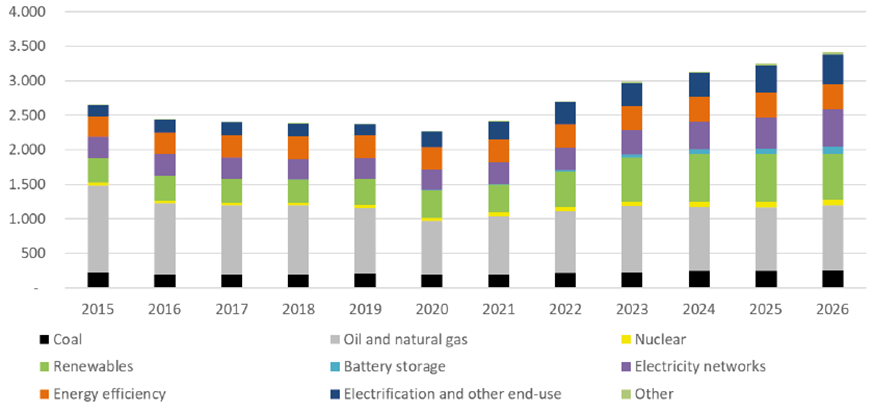
Global energy demand continues to expand. According to the International Energy Agency (IEA), global energy demand is expected to be between 8 and 14 per cent higher than current levels by 2035, depending on the scenario considered.3 The increase is likely to be driven primarily by emerging economies, particularly India and the countries of Southeast Asia. Total investment in the energy sector is expected to exceed USD 3.4 trillion in 2026 (Figure 1).
Global electricity demand is set to grow. Following average annual growth of around 3 per cent during the years 2015-2024, the IEA expects an increase of 7 per cent between 2025 and 2027, concentrated in the major economies, namely China, India, Southeast Asia, the United States and the European Union. This increase will be due to demand from industrial processes, the widespread adoption of heat pumps and electric vehicles, and the rapid expansion of data centres.4 In 2024, data centres accounted for approximately 1.5 per cent of global electricity demand, and their electricity consumption is projected to double by 2030.
Electricity is a more efficient energy carrier. All other things being equal, the electrification of energy uses makes it possible to reduce final consumption, since electrical technologies generally require less energy than those that make direct use of fossil fuels.5 Recent analyses by the IEA6 suggest that increasing the degree of electrification of the global economy, from the current 23 per cent to 35 per cent by 2035, would be economically beneficial, with a particular focus on transport, buildings and industrial sectors.
Despite the adverse policies adopted in some jurisdictions, investment in renewable energy continues to grow worldwide. All the major economies are expanding their installed renewable energy capacity significantly.7 Renewables are expected to account for 37 per cent of global electricity generation by 2026, surpassing coal as the world’s largest source for generating electricity.8 Two thirds of total energy sector investment has been directed towards clean-energy technologies and infrastructure this year, including renewable energy, electricity grids, energy storage systems, end-use electrification, energy efficiency, nuclear power and low-emissions fuels (Figure 1). In 2020, this share was almost 10 percentage points lower. It is a sign of the times that ambitious, clean-energy projects are being pursued even in fossil fuel-rich countries such as Indonesia.9
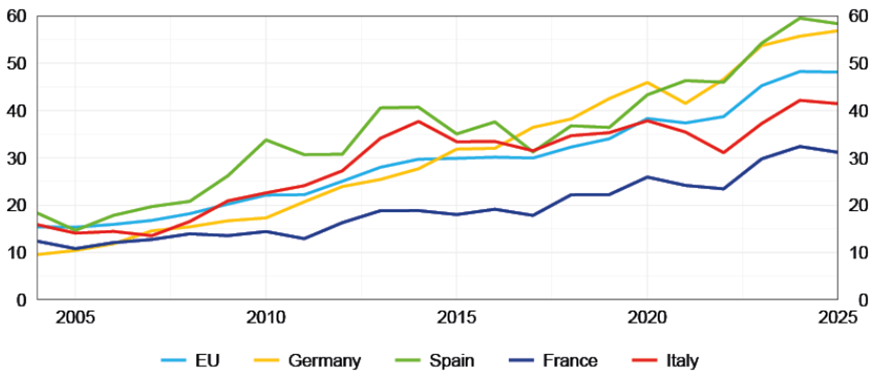
In Italy, the pace of new renewable energy installations has accelerated, particularly in the solar photovoltaic sector, but it is still below both the average level recorded across the European Union and the trajectory envisaged under the National Integrated Energy and Climate Plan (NECP).10 In 2025, renewable energy sources accounted for 41 per cent of electricity generation in Italy, compared with 49 per cent on average in the European Union (Figure 2).
Figure 2
Share of renewable energy sources in electricity consumption (1)
(percentage points)
Source: Ember.
(1) Consumption is calculated as the sum of electricity production and net imports. The data for France are affected by the considerable use of nuclear energy, which covered around 80 per cent of consumption in 2025.
The energy transition is indispensable for combating climate change. There is a broad scientific consensus on the existence of a causal link between fossil fuel use and global warming. The main economic models suggest that, although the costs of the energy transition are substantial, they are still lower than the economic and social damage resulting from inaction or a delayed transition.11 The argument that the transition must not be at the expense of business competitiveness or employment has understandably gained traction as part of the European policy debate. Nevertheless, it should be borne in mind that, in the medium to long run, these objectives are ultimately complementary rather than conflicting.
I will now consider some issues currently under discussion.
The first concerns the economic competitiveness of different energy sources. Where the spread of renewable energy used to be supported mainly through public incentives, its expansion is now driven predominantly by cost reductions and technological improvements.12
According to some influential studies, renewable energy sources have now become economically competitive with fossil fuels. This conclusion appears to hold, at current production levels, even after taking account of the costs associated with integrating renewables into the electricity system, including investments in networks, energy storage facilities, and the services required to ensure reliability and security of supply.13
Nevertheless, there is no shortage of more cautious assessments.14 This is a complex debate, bringing together engineering and economic factors, technological hypotheses, and forecasts regarding demand and energy prices. It does not seem controversial, however, that the economic competitiveness of renewable energy is now at the technological frontier.
The energy trilemma, i.e. the challenge of reconciling environmental sustainability, affordability and security of supply, is no longer as clear-cut as it once appeared.15 For countries such as Italy, which have high final electricity prices by international standards and a wholesale electricity pricing mechanism based on a marginal supply, it is plausible that the expansion of renewable energy sources, energy storage capacity, and electricity networks could reduce wholesale electricity prices. This would be achieved by reducing the number of hours during which prices are set by the most expensive generation technologies, typically natural gas-fired power plants.
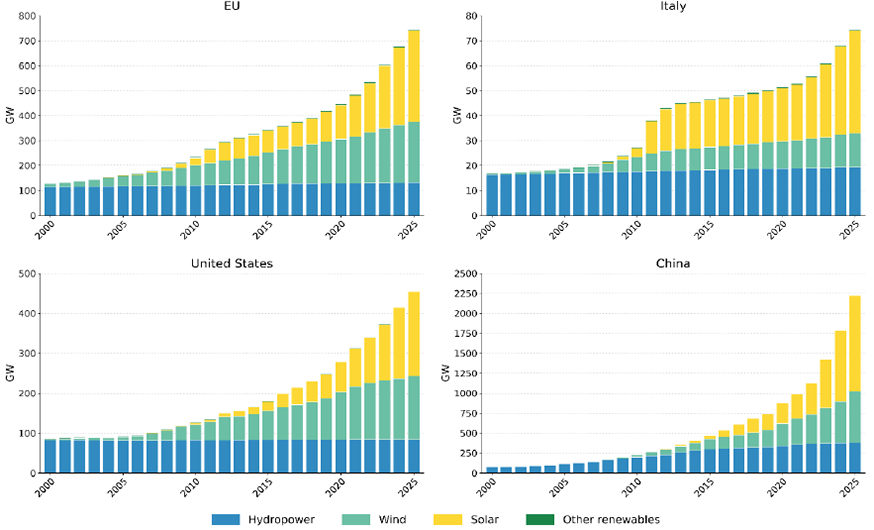
Figure 3
Installed renewable electricity capacity for Italy, the EU, China and the United States
Source: Calculations based on Ember data, Yearly Electricity Data.
A second area of debate concerns the impact of the energy transition on the strategic dependencies of economies with limited domestic fossil fuel resources. Such dependencies often involve supplier countries that are not always reliable or supply routes that pass through geopolitically unstable regions, creating a dangerous combination of dependence and uncertainty. The transition could generate new forms of dependence, relating to critical technologies and essential raw materials, the production of which is highly concentrated in a small number of countries.16 It could therefore be argued that the transition merely changes the nature of strategic dependencies rather than eliminating them.
Yet whereas dependence on fossil fuels requires continuous import flows, renewable energy installations, once they have been completed, substantially reduce the uncertainty associated with energy supply shocks and last for decades. The operational lifetime of renewable energy plants has actually increased significantly in recent years.17
Moreover, the share of renewable energy in total final energy consumption remains relatively limited, accounting for around one fifth globally and in Italy, and approximately one quarter in the European Union. There is therefore considerable scope for further expansion in order to diversify the electricity mix and reduce risk concentration.
A further consideration is that European industry has competitive strengths in several sectors that are critical to renewable energy production, including wind turbines and inverters.18
Overall, a further expansion of renewable energy sources in Europe is likely to contribute to reducing strategic dependencies. European initiatives such as REPowerEU and AccelerateEU are moving in this direction,19 as is the Industrial Accelerator Act, which aims to strengthen and revitalize Europe’s domestic manufacturing base.20
A third area of debate concerns the solutions to tackle the intermittency of renewable energy. When electricity generation exceeds demand in a given area and the surplus cannot be stored or transmitted elsewhere, it may become necessary to curtail production temporarily, resulting in a loss of electricity generation and, in effect, a waste of potential output. Conversely, during periods of excess demand, complementary sources of generation are required to support renewable energy.
A range of solutions is available. Storage capacity can be expanded, and grid interconnections as well as network management systems can be strengthened, allowing electricity to be transferred from locations and in periods characterized by surplus generation to those experiencing excess demand. In addition, various mechanisms, including price-based incentives, can encourage consumers to shift their electricity consumption towards periods of abundant supply, rewarding them for being flexible. These measures now appear indispensable.
Although the deployment of energy storage systems remains insufficient, the costs are declining significantly and investment is increasing at a steady pace. The same applies to the expansion of electricity networks and to demand-side management systems.21
Another option is relying on energy sources and technologies that complement renewable energy. The need to ensure the continuity and reliability of electricity systems will require recourse to such solutions for many years to come.22 The options available include natural gas-fired generation and nuclear power. In 2025, the latter accounted for approximately 9 per cent of global electricity generation. The prospects for nuclear power, however, differ substantially across countries depending on how advanced their nuclear sectors are, because there is still significant uncertainty regarding technological progress, construction costs and timelines, and financing arrangements. For Italy, which is just beginning to explore this path, any meaningful contribution will only materialize in the long term. Moreover, nuclear power would not free Europe from strategic dependencies relating both to the technology, which is currently concentrated in a limited number of countries, and to fuel supply.23
Overall, the debate on the optimal mix of technologies needed to mitigate the intermittency of renewable energy remains open. Solutions will emerge over the coming years through the interaction of technological progress, market forces and public policy choices, choices that should be clear and stable, and should not replace markets in the selection of technologies. Given that investments in this sector are inherently long-term, with the useful life of electricity-generation assets measured in decades when properly maintained, reducing regulatory uncertainty and ensuring a stable policy framework are more important than ever for fostering investment.
A final area of debate concerns the obstacles to the growth of renewable energy. In many countries, including Italy, much has been done to reduce delays in the authorization and connection processes for new plants, network infrastructure and storage facilities. Nevertheless, the procedures are still often quite lengthy, and it is sometimes difficult to disentangle the various factors underlying such delays,24 including local opposition to the installation of renewable energy facilities. This resistance could be mitigated by allowing local communities to share in the benefits generated by these investments, for example through reductions in electricity bills, measures to lessen the environmental and visual impact of projects, and environmental restoration initiatives. There are many examples of success in such projects.25
In Italy, the recent proposals aimed at rebalancing authorization powers by shifting responsibilities from regional authorities to the central government are worthy of note.26
3. The financial system: the role of information and of financial instruments in the energy transition
The energy transition requires substantial investment, and investment decisions ultimately rest with firms, households and public entities. Financial variables, notably the availability of funding and the terms on which capital can be obtained, are crucial in shaping such decisions, but a number of issues need to be clarified.
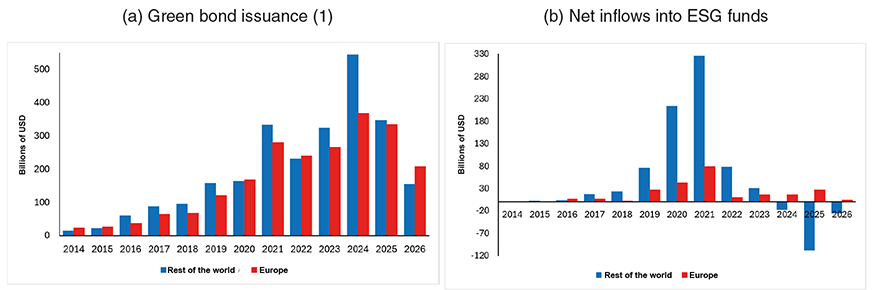
Only a few years ago, sustainable finance went through a period of rapid expansion, supported by climate policies and strong investor interest. The green bond market grew dramatically between 2014 and 2024, with Europe emerging as the world’s leading market for these instruments (Figure 4.a). Comparable trends were observed in ESG investment funds (Figure 4.b).
Figure 4
Evolution of sustainable finance
Source: DCM Analytics, LSEG, EPFR. Data are updated as of 30.06.2026.
(1) The geographical classification is based on the issuer’s nationality. Conversion into dollars is performed using the exchange rate at the time of placement.
It was thought at that time that finance could serve as the principal lever for initiating and steering the transition, sometimes even placing sustainability considerations ahead of traditional financial criteria. Today, however, this perspective appears to have largely run its course.27
Investors, financial intermediaries and their clients were, and remain, guided primarily by considerations of risk-adjusted returns.28 Setting aside, for the moment, the question of the ex ante financial attractiveness of sustainable investments,29 the key question is: what can be done to enable the financial system to support the energy and environmental transition as effectively as possible?
One widely shared answer among policymakers, regulators and market participants is that the financial system must be equipped to accurately assess both the risks and the opportunities that go with the transition. There are two important practical implications here. First, regulatory and economic policy choices should be as clear and stable as possible. Second, the information assets available to financial institutions and investors must be improved.
As noted above, uncertainty complicates investment decisions. Consider a firm or an investment project: poor quality, incomplete or non-comparable information increases uncertainty and, consequently, raises the risk premium on both equity and debt financing. Likewise, it reduces the value of the physical assets or financial instruments being traded. Similar effects may arise from changes in regulation and incentive schemes. When assessing information requirements and regulatory reforms, it is therefore essential to take these unwanted effects into account.
The European Union had drawn up an ambitious regulatory framework setting standards for corporate environmental and sustainability reporting, initially through the Non-Financial Reporting Directive (NFRD) and subsequently through the Corporate Sustainability Reporting Directive (CSRD). The Omnibus package introduced in 2025 in response to changes in the global environment, while pursuing the legitimate objective of reducing the regulatory burden on the economy, was a step backwards. For example, the number of Italian firms subject to sustainability reporting requirements, estimated at around 8,000 under the original CSRD framework, fell to approximately 1,000 under the proposed Omnibus revision.
The current review of the regulatory framework should aim not to undermine the investments already made by banks and firms in collecting and making use of these data, while preserving the availability of information that is relevant for investors and financial intermediaries.30
Banking and insurance supervision has played an important role in fostering the development and use of these information assets, encouraging financial institutions to equip themselves with the tools to adequately assess the risks and opportunities associated with the transition.31 For example, certain characteristics of a property, such as its energy-efficiency rating or its exposure to flood risk, can have a significant impact on its value as collateral.32
Let us now turn to some practical aspects of financing the energy transition in Italy.
Households account for approximately one quarter of the country’s final energy consumption. Around two thirds of this consumption are for space heating and cooling and for water heating.33 Improving the energy efficiency of buildings, in addition to being required under European legislation, including the Energy Efficiency Directive (EED) and the Energy Performance of Buildings Directive (EPBD), generally leads to financial benefits over the long term. For many households, however, it is difficult, if not impossible, to meet the upfront expense of such investments.34
To overcome this obstacle, financial products such as green mortgages and loans for the energy-efficient refurbishment of buildings have been developed. The share of such mortgages in Italy doubled between 2022 and 2024, reaching 12 per cent of new loans.35 Making banking regulation recognize the importance of investments aimed at improving the energy efficiency of buildings may further support the development of this market.36
The evidence available suggests that, all other things being equal, green loans have a lower risk than conventional lending, resulting in comparatively lower financing costs. Investments in energy efficiency tend to mitigate the impact of energy price shocks on the balance sheets of households and firms, thereby enhancing their resilience and improving their capacity to service debt.37
At the same time, certain aspects of the EU regulatory framework are hampering the development of these products. Attempts to apply of the definitions of ‘green’ lending as set out in the EU Taxonomy Regulation have thus far been limited by the technical complexity and insufficient clarity of the regulatory framework, the scarcity of relevant data, and the lack of harmonization in the metrics used across countries, for example in measuring energy-efficiency performance. The European Commission is addressing these challenges.38
Against this background, unofficial definitions of ‘green’ lending have proliferated, thereby complicating analysis. In Italy, these challenges are compounded by difficulties in accessing the administrative microdata that would substantially improve the credit assessment processes underpinning the origination of green mortgages.39 The problem could be alleviated by transposing the Energy Performance of Buildings Directive (EPBD) into the national legislation of EU Member States, although there are delays in its implementation across all Member States.40
A more harmonized definition of green lending would facilitate gathering stronger evidence on the riskiness of such loans. Over time, the accumulation of reliable evidence showing lower risk profiles could justify a reduction in capital requirements for these instruments, further lowering financing costs. This could then give rise to a virtuous circle.41
Banca d’Italia has recently published a proposal for a simplified definition of green loans, reconciling compliance with the requirements of the EU Taxonomy Regulation with the practices observed in the Italian market.42 This proposal could contribute to the adoption of a simplified definition at the European level, as well as to developing an orderly domestic green mortgage market. This issue will be discussed with the relevant European institutions.
To support the energy transition of firms, banks have acted on two fronts. On the one hand, they have expanded the range of products specifically designed to finance the electrification of production processes, the self-generation of renewable energy, and improvements in energy efficiency. On the other hand, they are working to incorporate both current and prospective energy performance into their credit assessments of corporate borrowers.43
This too could initiate a virtuous circle. A firm’s prospects depend not only on its current exposure to energy-price shocks, but also on its future exposure. Transition plans should therefore not be regarded merely as yet another regulatory constraint on businesses. Rather, they are strategic planning tools for energy-efficiency investments over a multi-year horizon, aimed at strengthening firms’ resilience and profitability.44
Some investments in renewable energy generation and energy-efficiency improvements appear well within the capabilities of the Italian business sector. For example, estimates by Cerved suggest that the full utilization of existing industrial rooftops for photovoltaic installations would double the solar capacity currently installed in the country. The investment required, estimated at between €30 and €36 billion,45 would be substantial yet achievable. A range of innovative contractual and financing arrangements are now available, including pay-as-you-save schemes and energy performance contracts, whereby the upfront cost of investment is borne largely by third parties, such as banks, and energy and service providers, and is repaid over time, in part through the savings generated by the investment itself.46Power purchase agreements (PPAs)instead enable counterparties to agree on the price of electricity supply over medium- to long-term horizons. These arrangements allow firms to mitigate their exposure to energy-price volatility, while giving producers a stable and predictable revenue stream for the development of renewable energy plants, typically characterized by high initial capital expenditure.
These financing arrangements are expanding in Italy but are still relatively uncommon. Financial intermediaries could foster their wider adoption not only by providing funding to the various parties involved, but also by acting as consultants in evaluating and arranging the financial side of the project.
Small and medium-sized enterprises (SMEs) require separate consideration. Surveys conducted by the European Investment Bank indicate that European SMEs, including those in Italy, are increasingly willing to invest in energy efficiency. Nevertheless, they continue to report greater difficulties than larger firms in accessing the financing required for such investments.47 A renewed effort by the banking sector is therefore needed to support SMEs in this area.
The Sustainable Finance Platform set up by the Italian Ministry of Economy and Finance has developed initiatives to raise awareness among both SMEs and financial intermediaries about the importance of sustainability-related data and to facilitate the data collection. A standardized framework has been developed to support dialogue between SMEs and banks regarding sustainability information.48 Its voluntary adoption could reduce compliance costs for firms while responding to the transparency recommendations issued by European institutions.49
Conclusions
The energy transition is not merely an environmental priority. The availability of energy that is affordable, secure and less exposed to geopolitical tensions has important implications for the production structure of the economy, for competitiveness and for the country’s economic security. This transition can foster investment, production activity and the growth of human capital, thereby exerting a profound influence on the development prospects of regions and economies.
There are no shortcuts to reducing energy costs, nor are there easy policy interventions. In the face of exceptional shocks, temporary and targeted measures may help protect vulnerable households and the firms most exposed to adverse impacts. By contrast, broad-based and long-term intervention would absorb substantial public resources, weaken price signals and fail to reduce dependence on foreign supplies. A structural response requires a more rapid expansion of low-cost, low-emission electricity generation capacity, thereby reducing the number of hours in which wholesale prices are set by the most expensive technologies; faster authorizations and grid connection procedures; investment in networks, storage facilities and European interconnections; and improvements in energy efficiency. Clear, stable and predictable public policies are part of this response.
Fixed-price and long-term electricity supply contracts, which are already available to households and firms, can help reduce both investment risk and price volatility.
Any public support mechanisms should continue to be allocated through competitive procedures, avoiding generalized and permanent subsidies. Consideration could also be given to further separating the charges that pursue redistributive or broader public policy objectives from electricity bills, in line with NRRP provisions.50 Such a shift to general taxation would not eliminate these costs, but would alter their distribution across taxpayers and consumers. By lowering the cost of electricity for end users, it would encourage the electrification process and mitigate the disproportionate burden of energy expenditure on lower-income households. Measures of this kind should be carefully assessed in light of their effects on households, firms and the sustainability of the public finances.
The role of the financial system is to assist in this process, not to direct it. Its task is to identify sound projects for financing, assess risks appropriately and support firms and households in undertaking the investments required by the transition.
There is growing evidence that ‘green’ loans, used by households and firms to improve the energy efficiency of buildings and production processes, or to finance the self-generation of energy, are associated with lower credit risk. As a result, all other things being equal, these forms of financing tend to carry a lower cost. A more harmonized definition of ‘green’ loans would make it possible to gather stronger evidence regarding the risk profiles of such loans and, over time, could justify reducing capital requirements for these instruments. This, in turn, could give rise to a virtuous circle.
Financial intermediaries can play an important role in the development of this market by extending credit on terms that reflect the lower risk profile of households and firms investing in energy efficiency improvements, by providing advisory services to smaller firms, and by collaborating with energy suppliers in the design of cost-effective supply contracts capable of supporting the expansion of renewable energy sources.
Achieving these objectives requires efficient intermediaries and well-functioning markets, firms willing to invest, stable regulation, and adequate information, enabling investors and public authorities to assess risks and seize the opportunities associated with the transition. Progress also depends on setting up a constructive dialogue among all the stakeholders involved.
Endnotes
* I would like to thank Matteo Alpino, Enrico Bernardini, Francesco David, Alberto Felettigh, Fabrizio Ferriani, Andrea Gazzani, Luciano Lavecchia, Valeria Lionetti, Tommaso Loizzo, Patrizio Pagano, Ludovico Ridi, Francesca Romana Rinaldi and Federico Schimperna for their valuable assistance in the preparation of this speech.
1 H. Ritchie and P. Rosado (2020) – ‘Energy Mix’, OurWorldinData.org. Accessed 31 August 2026.
5 For example, an electric vehicle converts more than 77 per cent of the electricity drawn from the grid into power at the wheels, whereas only 12-30 per cent of the energy contained in fuel is converted into useful motive power in internal combustion engine vehicles. See U.S. Department of Energy, FuelEconomy.gov, All-Electric Vehicles, accessed 25 September 2026.
7 Between 2010 and 2024, installed renewable energy capacity increased nearly eightfold in China, more than threefold in the United States, almost threefold in the European Union, and by roughly two and a half times in Italy relative to its 2010 level. This expansion was driven mainly by wind and solar photovoltaic technologies, whereas hydroelectric power recorded more modest growth.
9 Indonesia, the world’s third-largest coal producer, recently announced plans to deploy more than 100 GW of solar photovoltaic capacity within three years, an expansion equivalent to nearly seventy times its existing installed capacity. See Financial Times, ‘Indonesia’s Lessons for the Global Energy Transition’, 2 September 2026.
10 See Chapter 14, box ‘Electricity production from renewable energy sources in Italy’, Banca d’Italia Annual Report for 2025, 2026.
12 According to Banca d’Italia in its Annual Report for 2025, global installation costs fell substantially between 2010 and 2024: by approximately 87 per cent for solar photovoltaics, 55 per cent for onshore wind power, 48 per cent for offshore wind power, and more than 90 per cent for utility-scale battery energy storage systems.
13 The IEA World Energy Outlook 2025 estimates that the current cost of electricity generation from onshore wind and utility-scale solar photovoltaics in Europe, the United States, and China is lower than that of coal- and natural gas-fired generation, even when taking account of the greater difficulties relating to planning and dispatching. A system in which renewables are very widespread (around 95 per cent), together with more storage, would instead mean overall costs in line with those of natural gas-based systems in Europe and higher than those of comparable systems in the United States.
16 According to data from the International Energy Agency (IEA) and the U.S. Geological Survey, lithium mining is concentrated in Australia, Chile and China; copper production in Chile, the Democratic Republic of the Congo and Peru; nickel production in Indonesia, the Philippines and Russia; and cobalt production in the Democratic Republic of the Congo and Indonesia. China accounts for approximately 70 per cent of global rare earth extraction and for an even larger share of refining activities. China concentrates roughly 85 per cent of global solar photovoltaic manufacturing capacity, 80 per cent of lithium-ion battery production capacity, and more than half of global wind-equipment manufacturing capacity along clean-energy technology supply chains.
17 The expected service life of solar photovoltaic modules has increased from roughly 20 years in 2007 to 25-35 years (U.S. Department of Energy, End-of-Life Management for Solar Photovoltaics, 2026). Onshore wind turbines have traditionally had an operational lifetime of about 20 years, with floating offshore installations typically lasting around five years longer. More recent evidence indicates that their useful life may be extended to 25-30 years (NREL, Wind Turbine Drivetrain Reliability Assessment and Remaining Useful Life Prediction, 2021).
19 The REPowerEU plan was launched in 2022 with the objective of freeing Europe from its dependence on fossil fuel imports from Russia. The AccelerateEU initiative, introduced in April of this year, seeks to further reduce strategic dependence on external suppliers by promoting the development of domestically produced clean energy. It also includes temporary support measures for households and firms, as well as initiatives aimed at strengthening Europe’s electricity networks.
20 A further consideration, related but distinct, concerns infrastructure security. The incorporation of foreign-produced hardware and software into domestic electricity systems could create cyber-security and geopolitical vulnerabilities that require appropriate safeguards (European Council on Foreign Relations, How China Could Crash Europe’s Energy Grid and What the EU Can Do About It, 2025).
24 Globally, renewable energy projects with a combined installed capacity of 1,700 GW and energy storage facilities accounting for a further 600 GW were waiting to be connected by the end of 2025. See International Energy Agency (IEA), Electricity 2026.
28 There are, of course, investors who deliberately complement these ‘traditional’ objectives with alternative goals, such as decarbonization. The investment decisions of the Norwegian sovereign wealth fund, for instance, are also guided by climate and environmental considerations. There is evidence that such choices have had a significant effect on reducing greenhouse gas emissions among firms (F. Carpena, M. Castelluccio and J. Hjort, ‘Catalytic Divestment: The World’s Largest Investor’s Exit from Coal and Global Emissions’, July 2026). The Norwegian fund is, however, able to leverage its size to influence corporate outcomes through active ownership and engagement in shareholder decision-making. More generally, the impetus provided by investors that care about sustainability considerations does not appear, in itself, to be sufficient to generate a substantial impact in financing the climate transition. Numerous studies document the persistent gap between current investment levels and those required to meet the Paris Agreement objectives.
29 This question has been addressed in a growing body of empirical literature. Reaching a definitive judgement on the relative ex ante financial attractiveness of investments relating to the transition is difficult, as returns depend on uncertain and rapidly-changing factors, including the evolution of climate policies, technological progress, and investor preferences. The relationship between environmental and financial performance is therefore neither stable over time nor uniform across sectors and countries. See, for example, A. Persakis, ‘The Impact of Climate Policy Uncertainty on ESG Performance, Carbon Emission Intensity and Firm Performance: Evidence from Fortune 1000 Firms’, Environment, Development and Sustainability, vol. 26, pp. 24031-24081, 2024; D. Acemoglu, P. Aghion, L. Bursztyn and D. Hemous, ‘The Environment and Directed Technical Change’, American Economic Review, vol. 102, 1, pp. 131-166, 2012; and L. Pastor, R.F. Stambaugh and L.A. Taylor, ‘Sustainable Investing in Equilibrium’, Journal of Financial Economics, vol. 142, 2, pp. 550-571, 2021.
35 V. Lionetti, V. Michelangeli and L. Ridi, ‘’, Banca d’Italia, Questioni di Economia e Finanza (Occasional Papers), 1013, June 2026.
36 Article 229 of CRR3 (Regulation (EU) 2024/1623) stipulates that investments enhancing the energy performance of a property may be fully taken into account in the property’s valuation, without any cap. The resulting increase in collateral value would raise the share of the mortgage secured by real estate collateral, which attracts a lower regulatory risk weight than the unsecured exposure.
37 See A. Colabella, L. Lavecchia, V. Michelangeli and R. Pico, ‘Are Energy Bills Squeezing People’s Spending?’, International Journal of Microsimulation, Vol. 18, 3, pp. 1-25, 2025; D. Rusinova and M. Weissler, ‘Building Resilience: How Energy Prices Boost Home Efficiency’, ECB Blog, 2026; F. Ferriani and A. Gazzani, ‘The Impact of the War in Ukraine on Energy Prices: Consequences for Firms’ Financial Performance’, International Economics, Vol. 174, pp. 221-230, 2023; F. Ferriani and A. Gazzani, ‘The Invasion of Ukraine and the Energy Crisis: Comparative Advantages in Equity Valuations’, Finance Research Letters, Vol. 58, Part D, 2023; and F. Ferriani and M. Pericoli, ‘ESG Risks and Corporate Viability: Insights from Default Probability Term Structure Analysis’, International Review of Financial Analysis, Vol. 112, 2026.
38 The European Commission launched a public consultation in March 2026 on proposals to amend the technical criteria in the EU Taxonomy Regulation. In the same month, it sought technical advice from the European Supervisory Authorities (ESAs) on simplifying the sustainability-reporting requirements required by the Taxonomy framework. Further progress on these initiatives is expected from the Commission in the coming months.
39 For example, the information contained in the Energy Performance Certificates (EPCs), which are collected by regional authorities and subsequently transferred, with different timelines and procedures, to the national registry managed by ENEA (SIAPE), remains largely unavailable other than in aggregated form. A few regions, including Lombardy, Piedmont and the Autonomous Province of Trento, have opted to make their databases available as open data, thereby enabling more extensive analysis and research. See L. Lavecchia et al., ‘The Sustainable Data Gap in Italy’, IFC Bulletin 68, September 2026.
40 According to Article 22(2) of the EPBD, ‘Member States shall ensure easy and free access to the full Energy Performance Certificate for building owners, tenants and managers, as well as for financial institutions in relation to buildings included in their investment and lending portfolios and, subject to the owner’s authorization, for independent experts’.
41 P. Angelini, Opening Remarks at the Conference ‘UN Principles for Green Financing for Sustainable Real Estate, Infrastructure and Urban Transformation Projects’, Milan, 11 April 2024.
44 Banca d’Italia published its Transition Plan for Climate Change Mitigation and Adaptation for the first time in January 2026. The Plan outlines a series of investments to be implemented over the next decade (Banca d’Italia, Transition Plan for Climate Change Mitigation and Adaptation, 2026).
47 See EIB, Capitalizing on Europe’s strengths, 2026. Evidence from the Investment Survey 2025 for Italy indicates that 84 per cent of firms report having adopted measures to reduce their greenhouse gas emissions, compared with an EU average of 92 per cent. Access to credit conditions also appears to be improving, with only 10 per cent of Italian firms reporting dissatisfaction with the cost of financing, down from 22 per cent in the previous year; EIB Investment Survey 2025, Italy Overview.
49 On 3 July, the Commission adopted delegated acts introducing the European Sustainability Reporting Standards (ESRS) and a voluntary sustainability reporting standard for small firms. The standards will be in force from 1 January 2027.
50 A first step in this direction was taken in 2023 through the transfer to general taxation of a component of electricity system charges that had formerly financed the decommissioning of Italy’s nuclear power plants. This recommendation is broadly in line with a proposal formulated by ARERA in 2023.
index
Informativa sui cookie:
La Banca d'Italia utilizza cookie tecnici necessari al funzionamento del sito e cookie di terze parti: per maggiori informazioni e per sapere come abilitarli in modo selettivo leggere l'informativa sulla privacy. Utilizzare uno dei seguenti pulsanti per esprimere la propria preferenza. Se si clicca sulla X in alto a destra o sul pulsante “Chiudi/Rifiuta tutti i cookie non necessari” saranno attivati i soli cookie tecnici interni al sito.
About this site's cookies:
The Bank of Italy uses technical and third-party cookies for the operation of the site: for more information and to know how to selectively enable cookies, read the Privacy Policy.
Click on one of the buttons below to express your preference. If you click "Close/Reject all cookies", only the internal technical cookies of the site will be activated.



 Instagram
 YouTube
 X - Banca d'Italia
 Linkedin
 RSS
 E-mail Alert