Savings in a changing society
Saving means making a pact with the future: consuming less today to build prosperity for tomorrow. This pact only holds if savings can be channelled into investments that generate growth and if their value is preserved. Geopolitical tensions, the energy shock and the spread of artificial intelligence (AI) are putting both conditions to the test. Inflation is eroding the value of accumulated wealth, higher interest rates are changing its remuneration, and innovation is reshaping the opportunities and risks associated with its investment.
1. The global economic outlook
The conflict in the Persian Gulf and its impact on the energy markets are affecting the global economy. The closure of the Strait of Hormuz has driven fuel and gas prices to historically high levels, weighing on household budgets and driving up costs for businesses. Inflation has picked up again. The energy shock is now the main risk to the global economy.
Yet production has proved more resilient than expected, largely thanks to the boost that AI has provided to international trade, investment and equity prices. It is a revolution that is set to transform our economies and societies, and at the same time it is a competitive arena in which major powers vie for control of semiconductors and rare earths, and for access to energy.
However, this engine of growth is also a significant source of risk. Recent corrections in the equity prices of tech companies show just how rapidly expectations about the profitability of investment in AI can change.1 Scaling them back could have ripple effects across the global economy through trade, household wealth and investment.
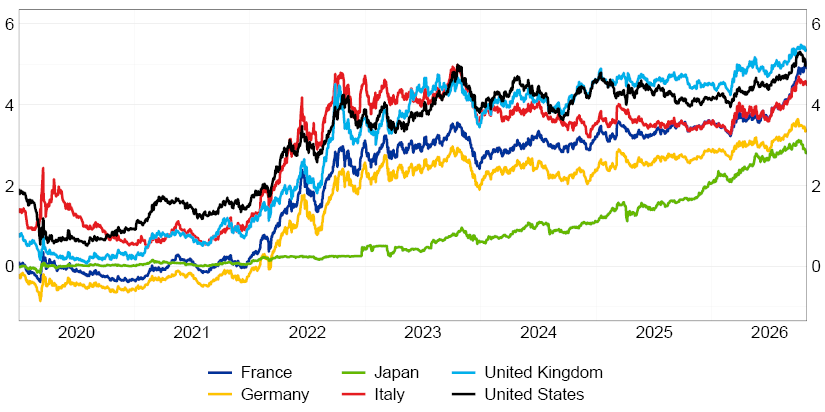
Another risk to growth and financial markets is the pronounced increase in long-term government bond yields across the main economies (Figure 1). This reflects expectations of persistently high inflation and of tighter monetary conditions; delays in the necessary fiscal adjustment in several countries; and the large-scale issuance of long-term securities by big tech companies, which intensifies competition for funding.2
Figure 1
Long-term government bond yields (1)
(per cent)
Source: Bloomberg.
(1) 10-year government bonds.
Pressures could also come from Japan: the sharp increase in yields on yen-denominated securities and the potential appreciation of the exchange rate could encourage Japanese investors to repatriate capital, reducing demand for foreign securities and pushing global rates further upwards.
Higher interest rates weigh most heavily on countries with high public debt, leaving less room for fiscal policy manoeuvre precisely when spending needs are increasing.
In Italy, prudent fiscal management in recent years has mitigated the effects of global rate hikes. The budget deficit has fallen from 9 per cent of GDP in 2020 to around 3 per cent. Several rating agencies have upgraded Italy's sovereign credit rating, helping to limit the widening of the spread over German government bonds; there is room for further upgrades.3 We must stay the course, especially in such an uncertain international environment.
2. Monetary policy in the euro area
For central banks, these developments complicate the pursuit of price stability.
In the euro area, consumer price inflation has doubled since February, to 3.8 per cent, almost entirely owing to the energy component. The pass-through of the shock to other goods and services has been limited so far: higher electricity production from renewable sources4 has cushioned the impact of gas price hikes on firms' costs. Core inflation barely exceeds pre-conflict values and the effects on expectations are limited to short horizons; wage growth has remained moderate.
Economic activity continues to expand. According to the European Central Bank's (ECB) projections, GDP growth will be around 1.2 per cent this year and the next,5 while unemployment will fall to historical lows. The spread of AI is benefiting Europe too: in the first half of the year, the service sectors most closely linked to digitalization accounted for about one third of value-added growth in both the euro area and Italy; investment in intellectual property also increased in both areas.
The outlook for prices is worsening: overall inflation is expected to remain above 2 per cent for several quarters, while the increase in core inflation could become more pronounced early next year.
The protraction of the crisis in the Middle East and pressures on the natural gas market, partly due to the need to rebuild European inventories, are driving risks to inflation upwards and risks to growth downwards. Against this background, the ECB Governing Council raised its key interest rates by 50 basis points between June and September, leaving them unchanged at yesterday's meeting.
Monetary policy cannot prevent price increases caused directly by the energy shock. But it can and should prevent them from becoming entrenched in the expectations and behaviour of households and firms, triggering a wage-price spiral that would be costly to stop. Preserving price stability means safeguarding the real value of savings and protecting less well-off households, which are more exposed to persistent inflation.
With inflation set to remain above target for an extended period and risks skewed to the upside, further increases in the policy rates could prove necessary. The rise in long-term yields, mainly due to global factors, is making financial conditions tighter; this must also be considered when gradually calibrating monetary policy.
The Governing Council will continue to make decisions based on a data-dependent and meeting-by-meeting approach. This will make it possible to assess the transmission of the energy shock to core inflation, but also to adjust the stance promptly if the international situation were to improve or if financial tensions were to act as a brake on the economy and, thereby, on inflation. Such flexibility requires clear communication: explaining each decision transparently is essential to preserve trust in the ECB's commitment to maintain price stability.
3. The European paradox: large savings and the technological gap
The European economy is currently squeezed between competition from China, now reaching into innovative sectors, and the lag vis-à-vis the United States in the AI supply chain.
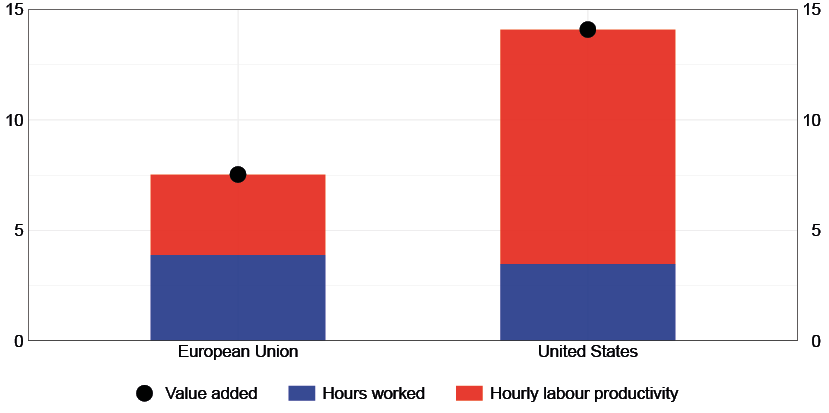
The gap with the US economy has widened. Between 2019 and 2025, US value added grew at twice the pace recorded in Europe. As hours worked followed a similar trajectory, the difference can be explained by productivity (Figure 2), to which information and communication technologies (ICT) contributed significantly.6
Figure 2
Composition of growth in value added between 2019 and 2025 (1)
(per cent)
Sources: Based on European Commission data, Annual Macro-Economic Database (AMECO), Spring 2026 Economic Forecast.
(1) The blue and red areas indicate the contributions of the individual components to growth, expressed in percentage points; the black dot represents the overall growth rate, as a percentage.
Europe's lag reflects lower investment in innovation. In the software sector, for example, over the past decade, the research and development expenditure of the most innovative US firms has gone from 8 to 17 times that of their European counterparts.7
Unless this trend is reversed, the gap could widen further. Such an outcome, however, is not inevitable.
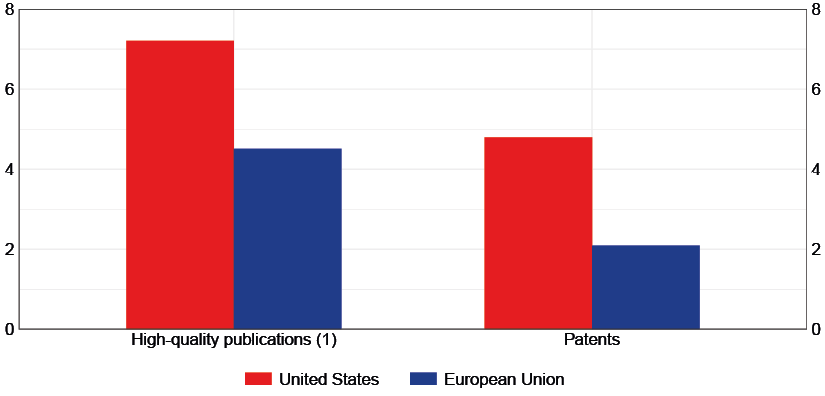
Europe continues to excel in the digital domain: while its lag in high-quality publications is smaller, it is more pronounced in patent production (Figure 3). The challenge is to harness these skills to develop high-tech goods and services and to nurture firms that can compete on the global stage. This requires greater public and private investment in the development and adoption of new technologies, as well as capital to finance innovative firms as they grow.
And yet, there is no shortage of resources. This is the European paradox: an economy that saves a great deal but struggles to channel those savings towards the innovation it needs.
Figure 3
Scientific research and patents in ICT technologies
(thousands, year 2021)
Sources: OECD, OECD Bibliometric indicators: Selected highlights, May 2026; Triadic Patents, WIPO technology domains, April 2026.
(1) High-quality scientific publications are defined as those in the first decile of the distribution by number of citations according to data from Scopus Custom Data and Scimago Journal Rankings.
Each year, the euro area saves one quarter of its gross national income, but a significant portion of these resources are invested abroad. Over the last decade, savings have exceeded domestic investment by an average of around €300 billion per year, equal to 15 per cent of productive investment.8 In the two years 2024-25, gross capital flows from the euro area to the United States averaged €785 billion annually, attracted in large part by the big tech firms.9
The problem, therefore, is not a shortage of savings, but the difficulty of deploying them profitably within Europe: what is lacking are specialized intermediaries, developed capital markets and adequate investment opportunities.
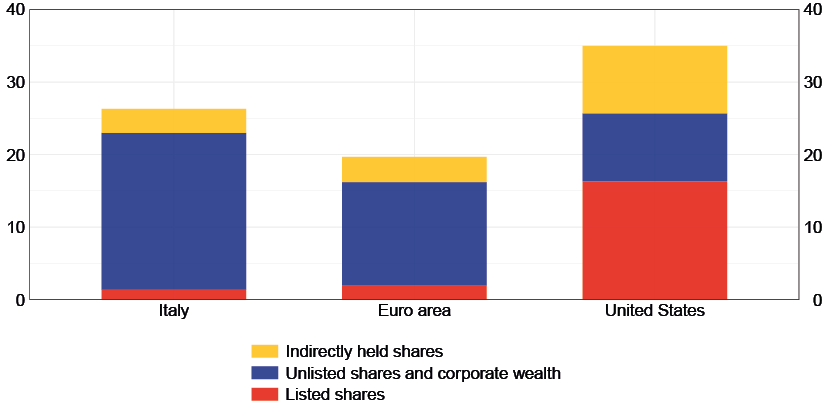
European households are less inclined to take risks than US households, but the gap is narrower than it appears looking at stock markets alone. In Europe, shares held through investment funds and listed shares held directly account for 5 per cent of gross wealth, compared with 25 per cent in the United States. When total stakes in unlisted companies are also taken into account,10 the share of equity capital rises to 20 per cent in the euro area and to 35 per cent in the United States (Figure 4).
Figure 4
Share of equity capital in gross household wealth
(per cent)
Sources: Estimates based on data from the Financial Accounts of the United States and the Survey of Consumer Finances (Federal Reserve Board) for the United States and from the Financial Accounts and Distributional Wealth Accounts (European Central Bank) for the euro area.
Much of the gap reflects the greater prevalence of unlisted family-owned firms in Europe. Investments in these firms, which are illiquid and concentrated, constrain portfolio diversification and reduce the scope for financing a broader range of innovative projects.
This is why, especially in the early stages of innovation, specialized intermediaries capable of pooling savings and diversifying risks - such as private equity and venture capital funds - are essential. Their development, which in the United States goes hand in hand with innovation, is being held back in Europe by a fragmented capital market.
The time has come to deliver on the long-standing European commitment to building a truly integrated capital market.
The Savings and Investment Union Strategy goes in the right direction. It expands the role of institutional investors, facilitates their cross-border activities and strengthens market supervision at European level.11 On this last aspect, the recent Ecofin agreement strikes a balance between greater integration and the role of national authorities.12 When implementing it, it will be useful to model it on the Single Supervisory Mechanism, which combines strong European leadership with the expertise of national authorities: their knowledge of markets and intermediaries, on-the-ground experience and proximity to savers.
Market integration also requires the completion of the banking union, including a common deposit insurance scheme that protects all depositors while taking into account the specific features of small banks.13 Finally, it will also be necessary to create a safe and liquid European asset, not as a step towards fiscal union, but as a benchmark for investors that can attract foreign capital and strengthen the international role of the euro.
Concrete action can be taken at national level as well. The permanent forum recently announced by the Italian Ministry of Economy and Finance - which will bring together institutional investors, market participants and competent authorities to support the financing of innovation - is a step in this direction.
However, finance alone is not enough. For savings to be invested in Europe, there must be projects capable of generating adequate returns and
the conditions needed to bring them to fruition: a fully integrated Single Market for goods and services; simple, harmonized rules; competitively priced energy; and joint investment in research and infrastructure.
Finance and the real economy reinforce one another. More developed capital markets make it possible to fund projects that currently struggle to attract funding; profitable projects, in turn, attract savings.
4. Savings, labour and pensions in Italy
Financial wealth needs to be put to better use in Italy too. Alongside this is another issue: household saving has declined over time, and those who need to save most, i.e. young people, have less chance of doing so. This is a key issue for the future well-being of an ageing society, in which supplementary pensions will increasingly have to augment public pensions.
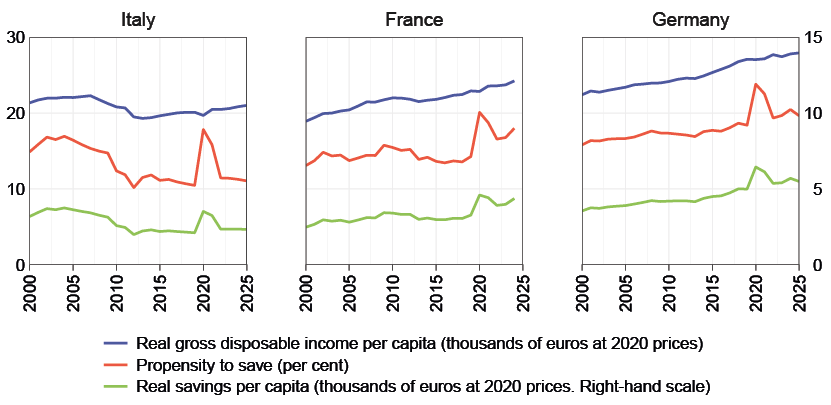
The decline in savings recorded since 2000 is due to stagnating income and a lower propensity to set money aside (Figure 5).
Figure 5
Income, savings and propensity to save
(thousands of euros at 2020 prices and per cent)
Source: Eurostat.
Real disposable income per capita fell slightly in Italy between 2000 and 2025, while it rose by more than one quarter in France and Germany. Real hourly wages remained broadly stable in Italy, reflecting productivity growth that was well below the European average.
The lower propensity to save is financially and demographically motivated. The decline in real interest rates following the launch of the euro has lowered the incentive to save; easier access to credit has also reduced the need to set aside financial resources before major outlays, such as house purchase. The share of elderly households, which tend to save less, has increased;14 the size of households has shrunk, lessening some of the reasons for saving linked to raising children.15
For those who are of working age today, however, greater life expectancy is another reason to put money aside: their savings need to finance longer periods of time and cover expenses that are hard to predict, especially for long-term care and welfare. The pension reforms of the last 30 years have also increased the role of private savings in supplementing income after retirement.
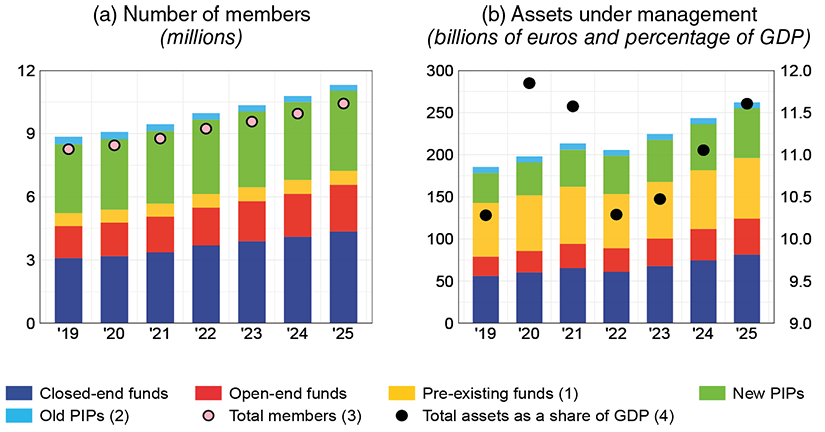
The decline in the propensity to save has come to a halt over the last decade, also because many households have begun to address these needs. Members of supplementary pension schemes have risen to over 10 million, equal to 40 per cent of the labour force; the financial resources accumulated account for over 11.5 per cent of GDP (Figure 6).16
Figure 6
Assets under management and members by type of pension fund in Italy
Source: COVIP.
(1) Funds reserved to firms' employees, in existence prior to the 1992 reform and primarily for people working in the banking and insurance sectors; these funds complied with the 2005 reform and are potentially open to new entrants. - (2) Old individual pension plans are gradually being phased out as they no longer accept new members; this is the result of their non-compliance with the reform set out in Article 23(3) of Legislative Decree 252/2005. - (3) Members of several funds are only counted once. - (4) Right-hand scale.
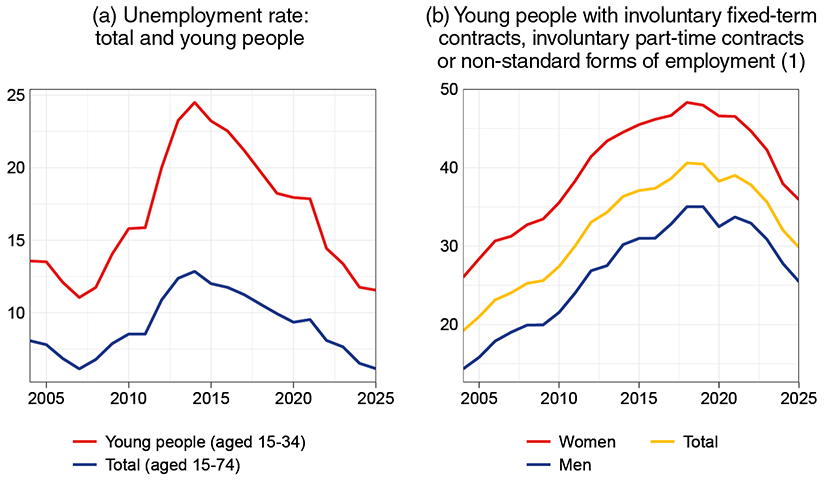
Young people, who really need them the most, make less use of supplementary pensions17 and struggle to make regular payments. The main reason for this lies in working and income conditions. While the share of employees aged up to 34 with temporary, involuntary part-time or non-standard forms of employment has fallen sharply in recent years, it is still high (Figure 7); more than one in ten of these workers earn a low income.18
Figure 7
Unemployment rate and share of young workers without full-time or permanent contracts
(per cent)
Source: Based on Istat data.
(1) Includes workers aged up to 34 with temporary employment who instead wish to work all year round; involuntary part-time workers; workers with non-standard forms of employment. The time series have not been fully comparable since 2021.
The difficulties are greater for young women, whose participation in the labour market is also hampered by the burden of family responsibilities.19
For the new generations, the fundamental answer is growth that can stabilize work paths and increase incomes: without continuity of contributions, no social security system can be fully effective.
Despite having made progress in recent years, supplementary pensions could also do more for young people. First of all, the number of members needs to be increased: automatic enrolment was reinforced by the latest budget law and is a step in the right direction.
In addition, participation in financial markets must be encouraged, adopting a long-term perspective. The recent proposals for saving tools that are accessible from birth are also noteworthy:20 starting to save early in life allows people to benefit for longer from the capitalization of yields and to adopt strategies in line with an extended horizon. The initiatives currently under discussion as part of the Budget Law appear to be consistent with this approach.21 To be successful, these tools should be simple and cheap, such as the savings and investment accounts (SIAs) proposed by the European Commission.
Financial education plays an essential role. Pension choices, such as how much to pay into a fund, what fund to join and how to get the final payout,
are decades-long commitments about which people need to be fully informed. Banca d'Italia has been engaged in this field for years.22
Financial education, including pension planning, has recently been included in the civic education programme that begins in primary school; the content is decided by the Ministry of Education and Merit in agreement with Banca d'Italia and other authorities.23 Making this reform operational will require appropriate teacher training; Banca d'Italia cooperates with the Ministry on this front too.
Finally, net yields on savings need to be improved over long horizons, which are crucial for those starting their working life. Many supplementary pension funds are still small and for some the costs for members remain high:24 further consolidation is desirable, following on from that of the last decade. Larger funds can access the skills needed to assess more complex investments.
Life-cycle investment plans25 and a share of assets, albeit a limited one, in diversified portfolios with higher risks and returns26 could offer better results to younger investors; they would also help to steer savings towards productive investments, in Italy and in Europe, and to solve the European paradox.
The interests of members must in any case remain the guiding principle for investment choices.
Conclusions
The European economy is showing more resilience than expected, as is the Italian economy. However, the outlook is clouded by the energy shock, as well as by geopolitical risks and financial tensions; the effects of inflation and of higher financing costs could escalate in the coming months.
Against this backdrop, the task of economic policy becomes more complex. Two basic needs remain unchanged: preserving price stability and maintaining a prudent fiscal policy, which are essential for protecting savings.
Yet they are not enough. Protecting savings requires an economy that can grow and generate income. This is the thread that links the issues discussed today: Europe and Italy have considerable wealth, but they are not able to fully exploit it to fund innovation and increase productivity. Without growth, it becomes difficult to support welfare, healthcare and social assistance in ageing societies; without growth, young people's chances of finding suitable work, becoming independent and starting a family are limited.
The future of young people and the security of the elderly rest on the same ability to create well-being. It is up to all of us in our various roles to ensure that today's savings support tomorrow's growth and that young people, through work, can build themselves a future.
Endnotes
- 1 The profitability of companies operating in the AI sector could be squeezed by the growing competition from open weight models, which can be used free of charge or at low cost, or by weaker demand brought about by higher usage costs. In recent weeks, credit default swap premiums on some technology companies have risen significantly.
- 2 For further details, see the box 'The recent rise in long-term government bond yields', Banca d'Italia, Economic Bulletin, 4, 2026.
- 3 Banca d'Italia's analyses, based on the methodologies used by the rating agencies, indicate that the state of the Italian economy and public finances could justify higher ratings than those currently assigned; see also O. Blanchard, D. Leigh and P. Mishra, 'Ratings, debt, and deficits: an exploration', IMF Working Papers, 195, 2026.
- 4 In 2025, the share of renewable sources in electricity production reached 50 per cent in the European Union and 43 per cent in Italy (12 and 8 percentage points higher, respectively, than in 2021).
- 5 Estimates adjusted for the volatility of Irish data; ECB, 'ECB staff macroeconomic projections for the euro area', September 2026.
- 6 The contribution of productivity in the United States was three times that of the euro area; the ICT sector accounts for about one fourth of the gap; see L. Carpinelli, R. Greco, S. Romano, L. Rossi and E. Viviano, 'The Great Divide: productivity dynamics in the United States and the euro area after the pandemic', Banca d'Italia, Questioni di Economia e Finanza (Occasional Papers), 924, 2025.
- 7 E. Nindl et al., The 2025 EU Industrial R&D Investment Scoreboard, European Commission, 2025.
- 8 Productive investment is defined as gross fixed investment net of residential construction.
- 9 This includes 'Other investment', which comprises deposits, loans and trade credit.
- 10 This includes direct holdings of unlisted shares, participating interests in partnerships and sole proprietorships.
- 11 The competent European authority is the European Securities and Markets Authority (ESMA); in Italy, the competent authorities are CONSOB and Banca d'Italia.
- 12 On 9 October 2026, the Ecofin Council agreed a general approach on the Market Integration Package (proposed Regulations COM(2025) 941 and COM(2025) 943 and proposed Directive COM(2025) 942); see also the Report by Banca d'Italia prepared for the Chamber of Deputies, 15th Committee on the Policies of the European Union, 'Proposed Regulations COM(2025) 943 final and COM(2025) 941 final and proposed Directive COM(2025) 942 final on the integration of financial markets (Market Integration Package)', Rome, 27 February 2026 (only in Italian).
- 13 One of the proposals being discussed is the introduction of a 'dual' scheme, in which large banks would join a European deposit guarantee fund, while small banks would rely solely on national funds. Without proper safeguards, this scheme would fragment the European deposit guarantee scheme and weaken Europe's capacity to respond effectively to crises affecting small banks.
- 14 Between 2000 and 2022, the share of households with a primary wage earner aged at least 65 rose from 29 to 37 per cent; there is a tendency to save less after retirement and, in part, to use accumulated savings.
- 15 In smaller households, some unavoidable expenditure has more of an effect on income, thereby lowering the capacity to save.
- 16 Supplementary pension funds comprise pre-existing pension funds, closed-end funds, open-end pension funds and individual pension plans. Professional bodies are excluded, since compulsory contributions make them comparable to the first pillar of the pension system.
- 17 The participation rate of young people in supplementary pension schemes is almost 10 percentage points lower than that of those over the age of 55.
- 18 Calculated based on INPS data for young people aged up to 34 in 2023; gross monthly full-time equivalent earnings. Low income is defined as being less than 60 per cent of the median in an age group.
- 19 Among women aged up to 34, the labour market participation rate is 43 per cent, 12 percentage points lower than for their male peers and 24 points lower than the general average. Young women who are not in employment, education or training account for 19 per cent of the total, compared with 12 per cent for young men.
- 20 M. Pepe, Annual Report for the year 2025, President's remarks, COVIP, Rome, 10 June 2026; see also E. Marro's interview with G. Fava, President of INPS, 'Per le pensioni dei giovani serve un terzo pilastro. Il vero problema è il lavoro', Corriere della Sera, 20 August 2026; and G. Stazi, opening speech at the meeting on 'Corporate Governance in Italia. Flessibilità e proporzionalità delle regole: evoluzione dei mercati e qualità della governance', jointly organized by CONSOB, the Italian Corporate Governance Committee and Assonime, Rome, 16 September 2026.
- 21 The press release of the Italian Council of Ministers of 28 October announced the establishment of a baby bonus fund that 'assigns an individual savings pot to newborns in 2027 into which an annual state contribution of €100 will be paid until they reach adulthood and into which households can also make payments via a specific tax deduction'.
- 22 Banca d'Italia runs financial education activities for teachers, students and adults, and also participates in the Committee for Planning and Coordinating Financial Education Activities (Edufin Committee), founded in 2017 to implement the relevant national strategy; see the 'Economics for all' website.
- 23 Article 25 of Law 21/2024. This law provides for the development of financial literacy from primary to secondary school. In January 2026, Banca d'Italia and the Ministry renewed their memorandum of understanding for the training of teachers, teaching materials and student initiatives.
- 24 There were 273 supplementary pension schemes at the end of 2025, of which 33 were closed-end funds. According to COVIP, over a 35-year horizon, the synthetic cost indicator averages 0.4 per cent per year for closed-end funds, 1.2 per cent for open-end funds and 1.8 per cent for individual pension plans. The lower cost of closed-end funds also reflects the economies of scale. Costs for open-end funds and individual pension plans are affected by the remuneration of sales networks, along with information barriers and competition levels.
- 25 For life-cycle investment paths, exposure to equity markets declines with age. Workers can benefit from the higher expected returns on equity, thereby limiting the risk of market fluctuations when they are close to retirement.
- 26 The share of venture capital investments is practically nil in the portfolios of Italian pension funds; it fluctuates between 1 and 3 per cent in the United States.

 Instagram
 YouTube
 X - Banca d'Italia
 Linkedin
 RSS
 E-mail Alert